
How Much Does a Hot Water System Cost in 2026?
It’s the question we get asked most: “what’s a new hot water system going to cost me?” The honest answer is that it depends on the type, the size and your home – but you deserve real numbers to plan around, not a shrug. So here’s a straight guide to what hot water systems cost on the Sunshine Coast in 2026, what’s actually included in the price and the running costs that matter just as much as the sticker price.
IN A HURRY? HERE’S THE QUICK ANSWER.
- Electric storage: Approx $1,300–$2,500
- Gas storage: Approx $1,600–$3,000
- Gas continuous flow: Approx $1,500–$3,500
- Solar: Approx $3,500–$6,500
- Heat pump: Approx $3,500–$6,000 (before rebates).
These are indicative ranges for a standard swap-over – your price depends on size, access and any upgrades. We always quote upfront after seeing the job.
What’s actually included in the price
A quoted price should cover more than the unit on the box. A proper supplied-and-installed price includes the system itself, the plumber’s labour, removing and disposing of your old unit, any new valves (like a tempering valve to keep your hot water at a safe 50°C), and the electrical or gas work to connect it. The ‘hidden’ costs that catch people out are usually compliance upgrades – bringing an old installation up to current standards, a new electrical circuit, or relocating a unit – which is exactly why an on-site quote beats a phone estimate.
Don’t forget running costs – the price after the price
The cheapest system to buy is often the most expensive to run, so it pays to look at both. As a rough guide for a family of four:
| System | Typical running cost per year* | Notes |
| Electric storage | $700 to $900 | Cheapest to buy, dearest to run |
| Gas storage / continuous | $300 to $550 | Mid-range to buy and run |
| Solar hot water | $100 to $250 | High upfront, very cheap to run |
| Heat pump | $150 to $350 | High upfront, very efficient, rebates help |
*Indicative only – real running costs depend on your usage, tariff and the weather. The point stands: a $1,500 electric unit can cost more over ten years than a $4,000 heat pump once you count the power bills.
Rebates can change the maths
Heat pump and solar systems often qualify for government incentives (federal small-scale technology certificates, and from time to time state rebates), which can take a meaningful chunk off the upfront cost and close the gap with cheaper systems. These schemes change, so ask us what’s current when you get a quote – we’ll factor any you’re eligible for into the price.
Repair or replace – which is cheaper?
If your system is under about eight years old and the tank is sound, a repair (a new element, thermostat or valve) is almost always the cheaper call. If it’s leaking from the tank, or it’s past ten years, you’re usually better putting the repair money toward a replacement that won’t fail again next winter. Our guide on the five signs your system needs replacing walks through where the line sits.
What affects YOUR price
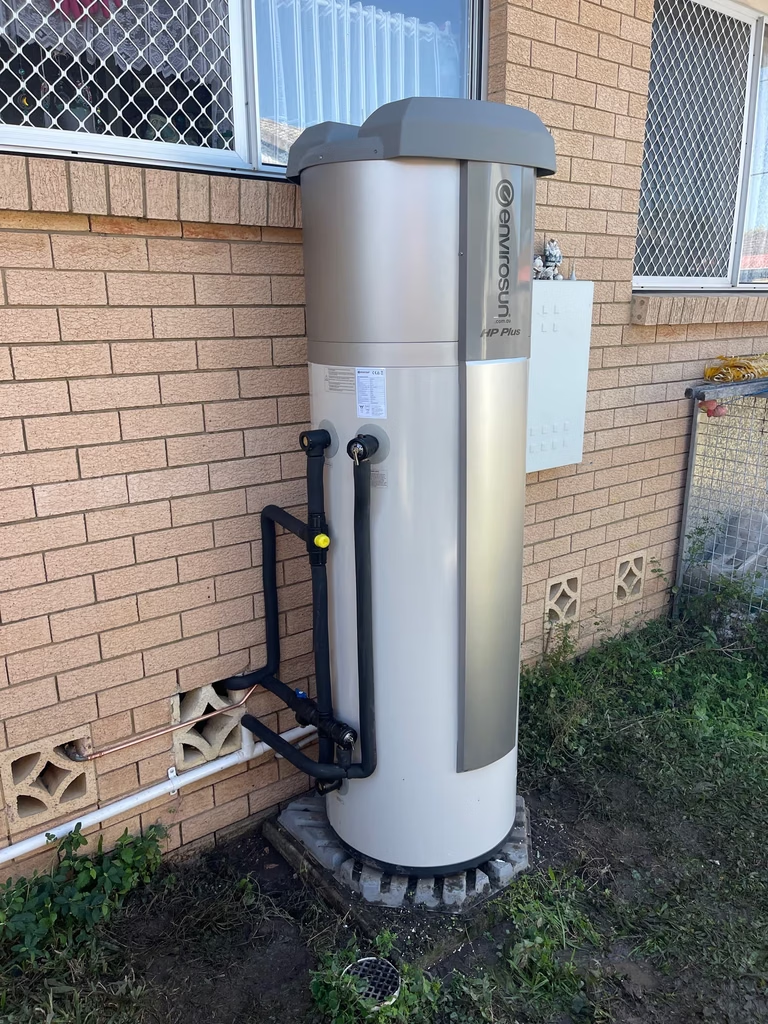
- Size: a two-person household needs a far smaller (cheaper) system than a family of six
- Changing type: switching electric to gas, or storage to continuous flow, adds connection work
- Location & access: moving the unit, tight access or roof work (solar) costs more
- Power supply: single vs three-phase, or a new circuit, affects electric and heat-pump installs
Can I keep using it? Is a leaking hot water system an emergency?
A light discharge from the relief valve while heating? All good – carry on and book a check when it suits. Water pooling under the tank, running down the outside, near electrics or a gas smell? Eeek! Treat that one as urgent – shut it down and give our team a call as soon as possible. Even a slow tank leak is worth same-day attention, because a rusted tank can let go without much warning a turn a tidy replacement into a flooded garage. We run 24/7 emergency plumbing across the Sunshine Coast for exactly these situations.
A note for Sunshine Coast homes
Two local things worth knowing. Coastal salt air shortens tank life, so systems near the water often need replacing a little sooner – worth factoring in when you choose. And our climate makes solar and heat pump genuinely cost-effective here, so if you’re replacing anyway, it’s the right moment to look at the cheaper-to-run options. We carry common systems and can replace most the same day.
How to get an accurate price
The only honest number is the one for your home. We give a fixed, upfront price after we’ve seen the job – no call-out-and-guess – and offer interest-free financing so a sudden replacement doesn’t have to hurt.
About the Author
This guide was written and reviewed by the licensed plumbing team at DYFA Plumbing. Darin Branks, QBCC Licence No. 15104310, has 10+ years installing hot water systems in homes across the Sunshine Coast.
Frequently Asked Questions
How much does it cost to replace a hot water system?
As a 2026 guide, supplied-and-installed: electric storage runs roughly $1,300–$2,500, gas storage $1,600–$3,000, gas continuous flow $1,500–$3,500, solar $3,500–$6,500, and heat pump $3,500–$6,000 (before rebates). Your price depends on the size, the type and your home, so we always give a fixed, upfront quote after we’ve seen the job.
What’s the cheapest hot water system?
Electric storage is the cheapest to buy. But it’s the most expensive to run, so over the life of the system it’s often not the cheapest overall – it’s worth weighing the running cost, not just the sticker price.
Which hot water system is cheapest to run?
Solar and heat pump are the cheapest to run, and both can attract rebates. Gas sits in the middle; electric storage is the dearest to run – which is why a cheaper electric unit can cost more over ten years than a dearer heat pump.
Are there rebates on hot water systems in Queensland?
Heat pump and solar systems often qualify for government incentives (federal certificates, and at times state rebates) that can take a meaningful chunk off the upfront cost. These schemes change regularly, so ask us what’s current when you get a quote and we’ll factor in anything you’re eligible for.
What size hot water system do I need, and does it change the cost?
Yes – a two-person household needs a much smaller (and cheaper) system than a family of six. Undersizing means running out of hot water; oversizing wastes money. We’ll size it to your household so you’re not paying for capacity you don’t use.
How long does a hot water system last?
Around 8–12 years for a storage tank. Coastal Sunshine Coast homes can be at the lower end, because salt air is hard on tanks and fittings – worth factoring in when you choose.


